
From Policy to Practice: Free Automation Resources to Help Deliver the NHS 10-Year Plan
From Policy to Practice
The NHS stands at a defining moment. The recent publication of the government’s 10-year health plan represents the most ambitious transformation blueprint in the NHS’s 76-year history – a comprehensive reimagining that promises to shift the service from hospital-centric reactivity to community-based prevention, analogue systems to digital-first delivery, and fragmented care to integrated patient journeys. Yet beneath the compelling vision lies a fundamental challenge: how does the NHS translate these bold aspirations into operational reality when the plan itself acknowledges being published without a detailed delivery strategy?
Delivering the ambition set out in the 10-Year Plan will require more than policy—it will demand practical implementation at scale. That means working with trusted experts like the e18 team who understand NHS pressures and have a proven track record in rolling out and scaling automation technologies that drive measurable impact on the ground.
To help Trusts navigate this challenge, the e18 Automation & AI Community Platform offers free, practical support. From case studies and webinar replays to peer forums and discussion groups, it’s a collaborative space designed specifically for NHS teams looking to start or scale their automation efforts.
Decoding the Transformation Challenge
The scale of change envisioned is considerable. The plan mandates that Neighbourhood Health Centres become the primary access point for NHS care, that the NHS App transforms into a comprehensive “front door” for patient interactions, and that single patient records enable seamless care coordination across previously siloed systems. Simultaneously, the government has set a demanding 2% annual productivity target without promising proportional increases in funding or staffing.
This mathematical reality presents an inescapable truth: the NHS cannot achieve these transformations through traditional approaches of incremental improvement or manual process optimisation. The current workforce crisis, with staff already stretched beyond sustainable limits, means that any solution requiring additional human resources is doomed to fail. The transformation requires a fundamental rewiring of how administrative processes operate – moving from labour-intensive, error-prone manual tasks to intelligent, automated workflows that liberate clinical professionals to focus on what they do best: caring for patients.
The government’s vision implicitly recognises this reality. Health Secretary Wes Streeting’s acknowledgment that delivery “won’t be easy” understates the complexity of simultaneously managing existing service pressures while implementing wholesale system transformation. Without systematic process automation, the NHS faces the impossible choice between maintaining current service levels and pursuing future transformation.
Where Automation Becomes Mission-Critical
The plan’s success hinges on several technological capabilities that are inconceivable without extensive automation. The NHS App, envisioned as offering “instant advice,” appointment booking, and comprehensive care management, requires seamless integration with backend systems that currently struggle with basic interoperability. This isn’t just about creating attractive user interfaces – it demands automated processes that can handle appointment scheduling, referral management, prescription processing, and clinical data integration across multiple legacy systems.
The commitment to establishing single patient records represents perhaps the most complex data integration challenge in UK public sector history. Current NHS organisations operate dozens of disparate systems with incompatible data formats, inconsistent terminologies, and fragmented patient identifiers. Achieving unified patient records requires sophisticated automated data migration, real-time synchronisation processes, and intelligent reconciliation systems that can handle the inevitable data conflicts and duplications.
Neighbourhood Health Centres, designed to operate “at least 12 hours a day and 6 days a week,” must function efficiently from their inception. These centres cannot afford the luxury of gradual process improvement, they require automated patient flow management, intelligent appointment scheduling, seamless clinical handovers, and integrated diagnostic request processing. The administrative complexity of coordinating care across multiple professionals, specialties, and care settings demands automation that can handle routine tasks instantaneously while flagging exceptions for human intervention.
The government’s EPR mandate presents an equally urgent automation imperative. EPR implementations notoriously struggle with data migration challenges, with many trusts finding themselves manually transcribing years of patient history. Intelligent automation can dramatically accelerate these implementations by automating data extraction, transformation, and loading processes, ensuring data integrity while reducing implementation timelines from years to months.
The Productivity Mathematics
The 2% annual productivity target represents more than an aspiration and is a mathematical requirement for NHS sustainability. Current NHS productivity figures reveal the stark reality: manual administrative processes consume vast resources while delivering inconsistent outcomes. A typical acute trust processes hundreds of thousands of patient interactions annually, each requiring multiple administrative touchpoints that are currently handled manually.
Consider the compound effect of systematic automation across key processes. Automated referral management can reduce processing time considerably, while simultaneously eliminating human error and improving data quality. Automated appointment scheduling can handle routine bookings instantly, freeing administrative staff for complex cases requiring human judgment. Automated clinical coding can ensure timely, accurate income capture while reducing the administrative burden on clinical staff.
More significantly, automation creates a workforce multiplication effect. Clinical staff freed from routine administrative tasks can focus on patient care, diagnostic activities, and complex case management. This improves productivity and enhances job satisfaction, reduces burnout, and creates the conditions for the NHS to become, in the government’s words, “not only the country’s biggest employer but its best.”
Bridging the Implementation Gap
The plan’s acknowledged lack of a delivery strategy reveals a critical gap between policy ambition and operational capability. While NHS England CEO Sir Jim Mackey suggests that detailed frameworks will emerge over the summer, the reality is that successful transformation requires proven, scalable solutions deployed by organisations with deep NHS experience.
This is where the choice of implementation partner becomes crucial. The NHS cannot afford to treat this transformation as a learning exercise – it requires partners who understand the complexities of NHS operations, the intricacies of clinical workflows, and the realities of managing change within pressured healthcare environments. The most successful automation implementations have emerged from collaborations between NHS organisations and providers who combine technological expertise with genuine healthcare sector experience.
The window for action is now. With political commitment secured and funding allocated, NHS leaders must move decisively to implement the technological foundations that will enable the plan’s ambitious vision. Delay risks not only failing to achieve the government’s objectives but also missing the opportunity to build genuinely sustainable solutions for future healthcare challenges.
Making the Plan Work in Practice
The NHS 10-year plan sets out an ambitious vision for transforming healthcare delivery. While the direction is clear, the practical challenge lies in building the operational foundations that can support these changes while maintaining current services.
Intelligent automation offers a pragmatic pathway forward. Rather than requiring wholesale replacement of existing systems or dramatic increases in staffing, automation can gradually enhance current processes, freeing up capacity for the new models of care the plan envisions. The NHS trusts that start implementing these solutions now will be better positioned to deliver on the plan’s objectives while improving day-to-day operations for both staff and patients.
Getting Started with Free Support from the e18 Community
For trusts unsure where to begin—or looking to scale in a more structured and collaborative way—the e18 Automation & AI Community Platform is a free, open-access resource built specifically for NHS teams. You don’t need to be an e18 customer to join, and the platform is designed to meet you wherever you are on your automation journey. Inside, you’ll find real-world NHS case studies, sample processes, webinar replays, and a calendar of drop-in sessions, peer forums, and knowledge hours. It’s a space created to share, learn, and connect—with no sales pitch, just a commitment to collaboration over duplication. If you’re ready to explore how automation can support your delivery of the NHS 10-Year Plan, join the community here and start tapping into the collective knowledge and experience of NHS peers nationwide.
More Information
Email: info@e18-consulting.com
Discover our latest resources...
 Published On: June 11, 2026
The same trusted NHS team, now backed by Digital Workforce e18 Innovation is part of...
 Published On: March 23, 2026
A recent HSJ Daily Insight piece by Steve Black posed an uncomfortable question: how much...
 Published On: March 20, 2026
e18 Innovation recently supported the United Lincolnshire Hospitals & Lincs Community Charity Golf Day at...
 Published On: March 18, 2026
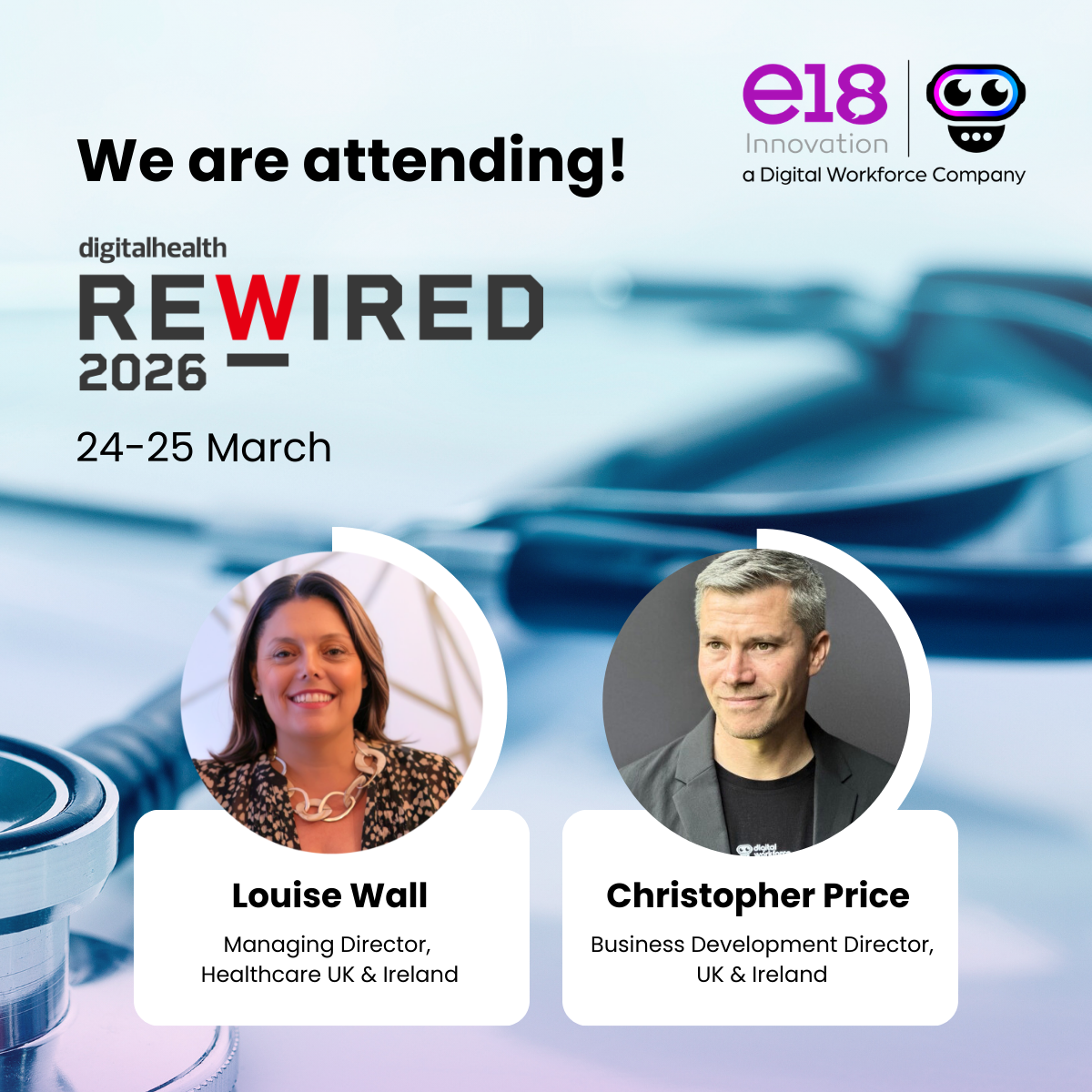
e18 Innovation will be attending Digital Health Rewired 2026, taking place on 24–25 March in...
